
Corporate Gifts for Clients: A Smarter Corporate Gifting Strategy
Corporate gifts for clients work better with a strategy. Learn how to choose client gifts that get remembered, build relationships, and create follow-up. 200 gifts. 12 thank-yous. 0 meetings. That was my client’s result after spending $8,000 on corporate gifts for clients. Here's how we fixed it.
3/14/20265 min read
Corporate Gifts for Clients: A Smarter Corporate Gifting Strategy
Why Most Corporate Gifts Fail
A lot of businesses make the same mistake with corporate gifting: they confuse sending gifts with having a strategy.
Everyone gets the same gift
Top clients, active clients, warm prospects, and old contacts should not all get the same thing. When every relationship gets the same box, the gift stops feeling thoughtful and starts feeling generic.
The timing works against them
A lot of corporate gifts get sent at the exact same time everyone else is sending theirs.
That means your gift lands in the middle of a pile and disappears with the rest.
There is no follow-up plan
This is where a lot of corporate gifting falls apart. The gift gets shipped, then nothing happens. No follow-up. No reason to reconnect. No conversation built around it. The gift becomes the end of the interaction instead of the start of one.
What a Better Corporate Gifting Strategy Looks Like
The fix is not spending more. The fix is building a plan before you choose the product.
Segment your client gifts
Not every client should receive the same gift.
Top clients
Choose premium corporate gifts that feel useful, elevated, and worth keeping. Think long-term visibility and daily presence.
Active clients
Choose something polished, practical, and on-brand that shows thought without blowing the budget.
Warm prospects
Choose client gifts that are relevant, easy to use, and designed to keep your brand top of mind.
The goal is simple: match the gift to the relationship.
Choose corporate gifts that fit the client
The best corporate gifts are not chosen because they look expensive or because they can hold a logo. They work because they make sense for the person receiving them.
A useful gift gets used. A thoughtful gift gets remembered. A strategic gift gives your brand a reason to stay in their world.
Send corporate gifts before the pileup
If you want your corporate gifts to stand out, do not wait until the rush. Sending earlier gives your package a better chance of being noticed, opened, and remembered.
You do not stand out because you spent more.
You stand out because you showed up before the clutter.
Make the gift lead to a conversation
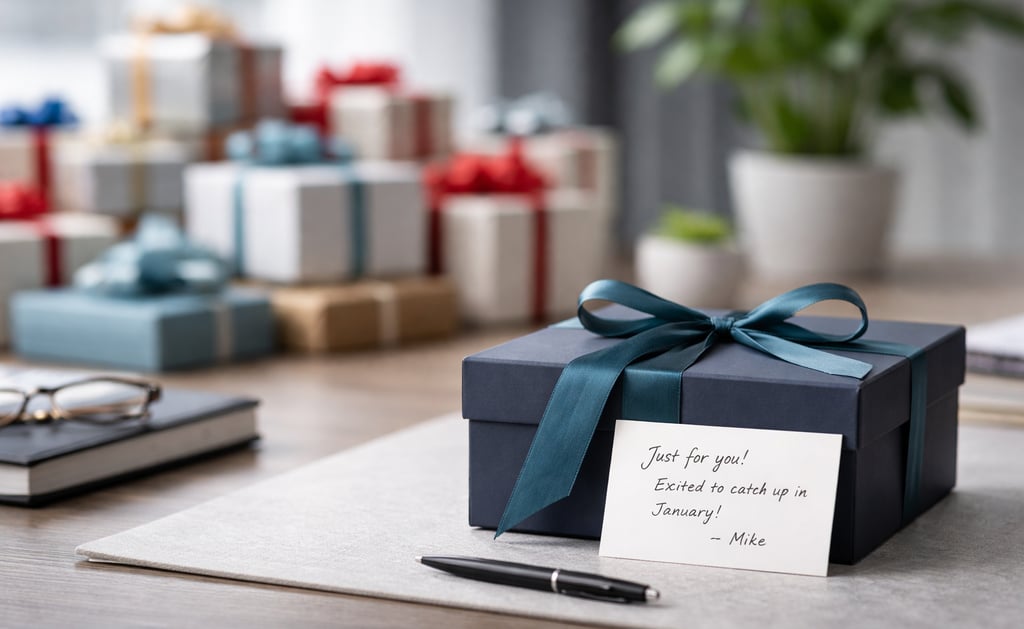
The best client gifts do not just arrive. They create a reason to reconnect. Include a short personal note. Build in a natural follow-up. Give the gift a job to do.
Because the gift is not the outcome.
The conversation is.
Build your follow-up around the gift
Do not wait until weeks later to figure out what happens next. Your corporate gifting strategy should include the follow-up before the gift ever ships.
That way, when you reach out again, you are continuing a warm interaction instead of sending another cold email that gets ignored.
The Real Goal of Corporate Gifting
Corporate gifting should not be a box-checking exercise. It should help you stay top of mind, strengthen relationships, and create momentum with the people who matter most.
The gift opens the door.
Your follow-up walks through it.
That is the difference between sending branded stuff and using client gifts strategically.
Questions to Ask Before You Order Corporate Gifts
Before you spend another dollar, ask yourself:
Who are your top clients?
These are the people who may deserve your highest-touch corporate gifts.
Who are your active and recurring clients?
These relationships need reinforcement and visibility.
Which warm prospects do you want to stay connected to?
A thoughtful client gift can keep the door open without feeling forced.
When are you shipping?
Choose a date that gives your gift the best chance of being noticed instead of buried.
What is your follow-up plan?
Write it before the gift goes out.
Final Thought
Before you order anything, ask:
Is this gift starting a conversation—or ending one?
That one question will save you from wasting money on corporate gifts that look nice but do nothing.
Want Better Results From Your Corporate Gifts?
Corporate gifts should do more than look good for five minutes. So, if you need help choosing corporate gifts that actually get remembered, visit my Work With Me page and book a call to build a smarter strategy for client gifts that fit your brand, your budget, and your goals.
Download my Fit, Function & Flow PDF for the strategy behind better branded products, or browse my Gift Giving Catalog for client gift ideas and inspiration - many with a minimum order of just one.
200 gifts. 12 thank-yous. 0 meetings. That was my client’s result after spending $8,000 on corporate gifts.
Good packaging. Premium products. Logo front and center. And still, nothing moved.
The problem wasn’t the budget.
It wasn’t the products.
It was the strategy.
Here’s the truth: price does not equal thoughtful. And putting your logo on something does not automatically make it useful.
A couple of weeks ago, a new client came to me with a very familiar problem.
Last year they spent $8,000 on holiday gifts.
200 gifts. Nice stuff. Good packaging. Logo front and center.
And what did they get?
12 thank-you emails (that’s about 6%).
Zero meetings. No. momentum.
The issue wasn’t the budget. It was the plan. There wasn’t one.
Here’s the truth: price ≠ thoughtful.
And putting your logo on something doesn’t automatically make it useful.
Where it went sideways
They did what most businesses do every December:
Everyone got the same gift. VIP clients, warm leads, “met once at an event three years ago”… all treated like they had the same value.
They sent it when everyone else did. Mid-December. Their gift landed with 47 others and blended into Gift Mountain 2024.
No follow-up baked in. They shipped and hoped. Then January rolled around and they were back to cold outreach. The gift didn’t create a conversation because they didn’t tell it to.
So we reworked it.
What we’re doing this year instead:
1. Segment ruthlessly
Not everyone gets the same thing.
Top 20 clients: premium, useful, keeper-level. Desk worthy. Long-term visibility. (I’ve got a product that’s still being seen after 29 years—see the link below.)
Active clients: still good, still on-brand, solves something for them. Shows you see them—without blowing the budget.
Warm prospects: thoughtful, daily-use. You want to stay present.
The point: match the gift to the relationship, not to what you think “holiday gifting” is supposed to look like.
2. Send before the December avalanche
Ship in late November or very early December.
That way your gift shows up when people are planning, not drowning. Fewer boxes = more attention. You stand out because you arrived early, not because you spent more.
3. Make the gift do the talking
The gift isn’t the outcome. The conversation is.
Include a short personal note and a reason to follow up—so when January hits, you’re circling back to something warm, not another “just checking in” email.
And don't be surprised when you receive a thank-you first. (Because that's what happens when you choose the right gifts for your clients.)
The real point.
Holiday gifting isn’t about doing it because "we do it every year." It’s about staying top-of-mind when Q1 decisions get made.
The gift opens the door.
Your follow-up walks through it.
So ask yourself:
“Is this gift starting a conversation—or ending one?”
What to do now
Before you order anything:
List your top 20.
List your active/recurring clients.
List the warm prospects you want to keep close.
Pick a ship date before the chaos.
Write the follow-up you’ll send after it lands.
Next week I’ll dig into how to choose gifts people actually want to keep (and not toss in the break room).
—Barbara
I’m Barbara Hobart. Since 1994, I’ve helped everyone from E! Entertainment Television to Fortune 500s to growing businesses turn branded merch into a strategy that gets remembered—not landfill with a logo.
P.S. Want to see what long-term ROI looks like in real life? I just dropped a YouTube video about a T-shirt I created for E! Entertainment's True Hollywood Story that people are still wearing 29 years later. Watch it here.
Creating Kickass Branded Merch since 1994.
30 years. Over 1M+ products created. Generating millions in measurable revenue for my clients.
Sign Up & Get My Strategic Swag Newsletter:
© 2026 Barbara Hobart. All rights reserved.
Follow me:
Join my FREE community Get Your Merch Made